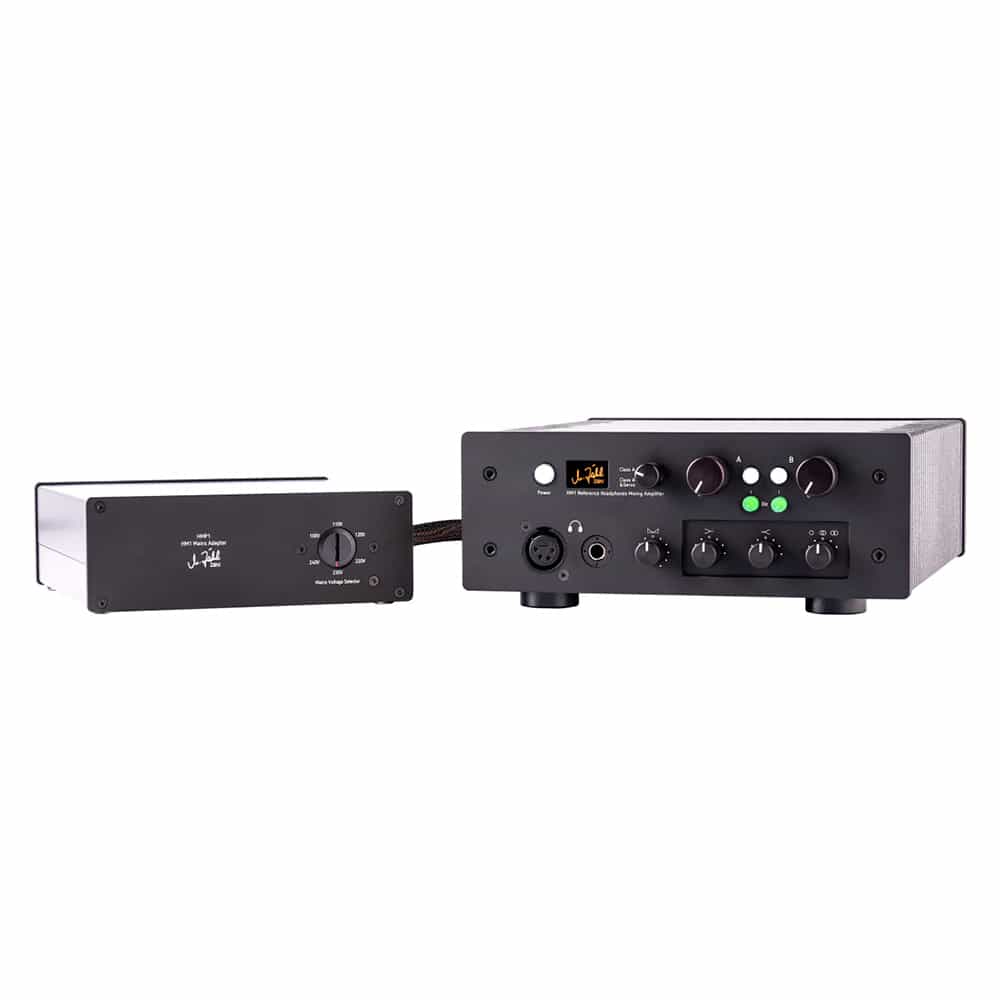


The Zahl (pronounced Zaehl) HM1 is a high-quality analog, Class A reference headphones mixing amplifier created with no compromises to provide an exceptional degree of transparency and clarity that will satisfy both discriminating professionals and audiophiles. The Zahl HM1 also has two distinct stereo source inputs with cross-fade, a precise two-band EQ, and a stereo base control. Its design is intended to provide the most lifelike replication possible. Two Different Power Stages The Zahl HM1 has two operating modes: Class A and Class A Servo. The first mode produces the clearest sound, with no crossover distortion and no artifacts that cause negative feedback. The second mode uses the same Class A circuit but incorporates negative feedback to fix mistakes between the power amplifier and the headphones. While both modes provide technically better performance, each will appeal to a different audience. Mixing Features: The HM1 has two input sources that may be utilized to do essential A/B comparisons of various DA converters, cartridges, mixes, or effects. Each input has a separate volume control for accurate level matching. Each input may be either harshly switched or slowly cross-faded. Dual mono design. The HM1 has a dual mono design that carefully separates the left and right channels, preventing any interference between them. Each channel includes a separate power supply for the preamplifier and power amplifier stages. Furthermore, the Mains transformer has independent and entirely potential-separated windings for each channel, with filtering, voltage control, and rectification tailored to each channel. Power Stage Class A – HM1 Realisation The HM1 power stage generates huge power reserves, as seen by its idle consumption of about 40W. The output power is more than enough for any application, and in the millisecond range, it increases significantly. The output resistance is quite low. The optimal working point of the power stage was first determined by theory, then by measurements on sample units, and then refined by extensive hearing tests with professionals, particularly mastering engineers. The same principle applies to component selection. This thorough design approach generally compensates for the potential shortcomings of Class A, which are discussed in the theoretical paragraph below. Class A and Servo – HM1 realization To take Class A to the next level, we use a simple but brilliant idea: we combine the best of Class A with the best of negative feedback amplifiers: Class A operation is supported by negative feedback (“Servo”). There is no crossover distortion, thus there is nothing for the feedback circuitry to fix. Rather, it just corrects the faults caused by the interaction between the power amplifier and headphones. The feedback channel is built such that no artifacts are produced during the correction. The output resistance decreases to a value less than the total of the headphone cables and connections. This allows for fine control of headphone systems. With the HM1, any headphones will sound like they should. A/B contrast. For this reason, the HM1 features two inputs with separate level control and on/off buttons. Exact level matching is required for an accurate A/B listening comparison. By the way, the on/off function may also be managed using a cable remote control, allowing for a blind comparison.. Sound Adjustment This stage is not intended to have a significant impact on sound quality. As a rule, all audio equipment attached to the HM1 is of the highest quality; a traditional tone control would be inappropriate. Dual Mono vs. Balanced Amplifier Design With its dual-mono architecture, the HM1 has the same benefits as a balanced output stage while avoiding the disadvantages. ¼-inch jack compatible. The HM1 design allows for the smooth operation of unbalanced headphones with ¼-inch jack connectors. Line Inputs. Each input has another switch that adds 15dB gain. This guarantees that even signals at low levels may be handled without issue. Line Outputs Connect active speakers, power amplifiers, and other devices. Power amplifiers, active speakers, level meters, and other components may be driven from both balanced and unbalanced outputs. If, for example, the HM1 is used to compare two stereo sources, the result may be recorded via one of the outputs. The same is true when utilizing the HM1 as a mixing console. Realization inside the HM1. The HM1 has a separate power supply for preamplifiers and power amplifiers for the left and right channels, respectively. Each channel of the main transformer has its windings that are entirely potentially isolated. Rectification, filtering, and voltage control for each channel are distinct. Another winding is used for logic circuitry and front-panel indicators, along with independent rectification, filtering, and voltage control. The ground potentials of the two channels are joined at a single point, however, this is merely for potential equalization; signal currents cannot be combined.
Related products

DOG BOWLS & FEEDERS
$ 83.97

DOG BOWLS & FEEDERS
Beyerdynamic DT 990 PRO X Professional Open Back Studio Headphone
$ 97.52
$ 90.17

DOG GROOMING
$ 97.93
DOG GROOMING
$ 56.83
DOG BOWLS & FEEDERS
$ 91.52

DOG BOWLS & FEEDERS
$ 96.52